Lexington, KY · Garage Door Service
Lexington homes built between 1956 and 1991 often carry original hardware that wasn't sized for today's insulated doors. We install doors matched to that stock and our cold-winter climate.
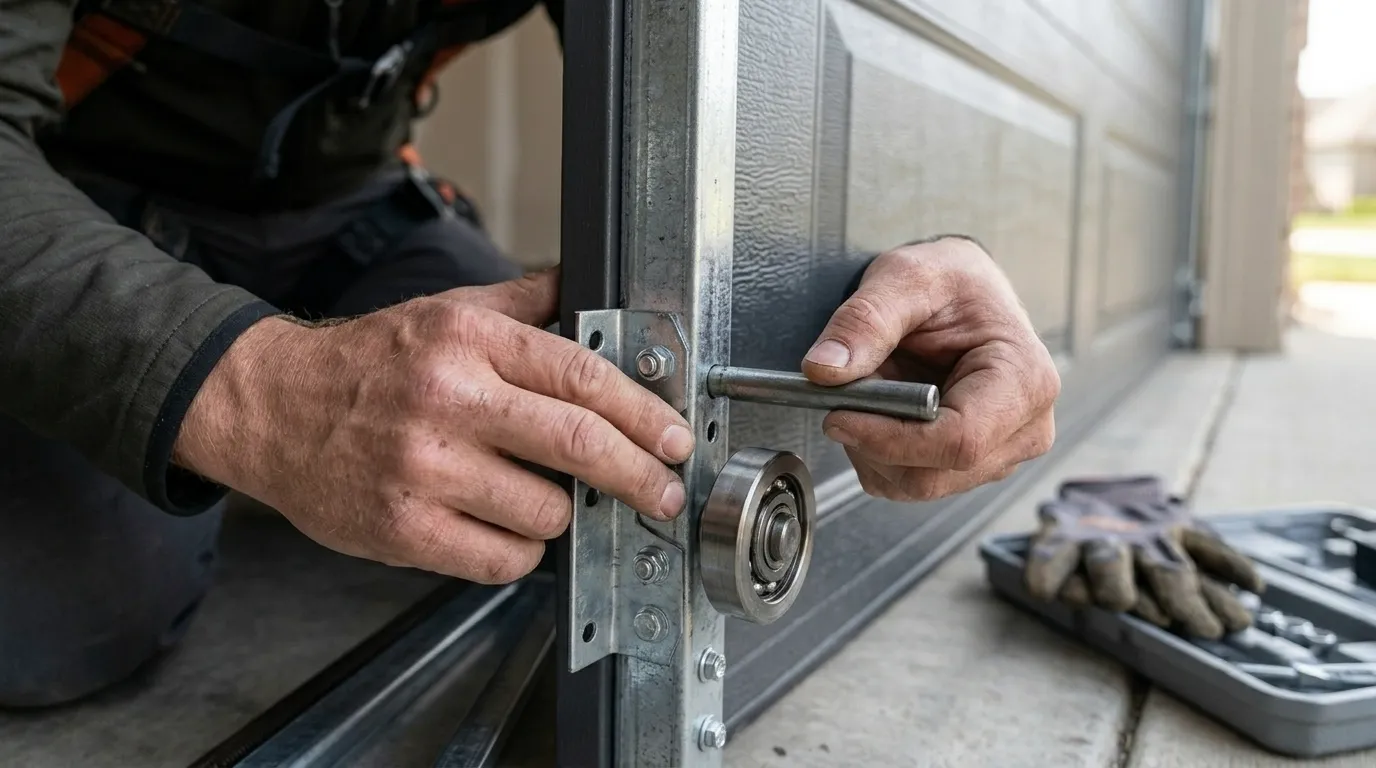
Most of the installs we run in Lexington aren't a straight swap. Houses across the five main areas of town went up mostly in the 1960s and 70s, with the broader range running 1956 to 1991 and a median build year of 1979. That means the opening itself is often a slightly odd size by today's standard door increments, and the framing behind the trim was built for a single steel panel door with no insulation value at all. We start by measuring the rough opening and checking the header for how it was actually framed, not how a spec sheet assumes it was framed. Then we size a door and track system that fits that opening without reframing the jamb, unless the jamb has already failed - which happens more than people expect on houses from this era. We set the opener to match the door weight, not a generic setting, because a door built for 1970s hardware moves differently than a door built last year. That's the part that gets skipped when a job is rushed, and it's the part that causes half the service calls we get later.
Lexington sits in a moderate-cold climate band, which means real freeze-thaw cycles every winter, not just a cold snap or two. On a house built in the 1970s or earlier, the garage door and its seals were never designed with that cycling in mind - insulation standards for garage doors didn't really exist yet. Over 40 to 60 years, that combination of age and repeated freeze-thaw works on the panel seams, the bottom seal channel, and the track alignment at the same steady rate. It's not damage from one storm; it's wear from thousands of small temperature swings acting on hardware that was already old. That's why we see so many install calls come from houses in the older pockets of the five main areas rather than newer construction - the newer stock simply hasn't had the decades of cycling yet.
The usual sign isn't a door that won't open. It's a door that opens unevenly, drags on one side, or lets a visible line of daylight along the bottom seal even when it's fully down. On a lot of the 1960s-70s builds we go into, the original opening was framed a half-inch or more out of square, and it stayed that way for decades because the old single-panel door was forgiving enough not to show it. A modern sectional door with tighter tolerances will show that same framing flaw immediately - binding at the rollers, a track that needs constant readjustment, or a seal that never sits flat against the slab. Homeowners often think this means the new door is defective. Usually it means the opening needs correcting before the door goes in, which is a different job than hanging a door.
Some of this is fine to do yourself. Swapping weatherstripping, tightening loose hinges, lubricating rollers - none of that needs a truck. Full installation on an opening that's out of square is not a DIY job, and we'll say that plainly even though it costs us work: setting a new sectional door into a framing flaw without correcting it first just moves the binding problem into the new door, and you'll be calling someone within a year anyway. If your house falls in that 1956-1991 range and the opening hasn't been touched since it was built, get the frame checked before you buy a door, whether that's from us or someone else. That one step is the difference between a door that lasts and one that fights you from week one.
Lexington's moderate-cold climate means the wood or metal framing around your opening expands and contracts every freeze-thaw cycle. On houses built in the 1960s or 70s, decades of that cycling have shifted the opening slightly out of square, and a new door with tighter tolerances shows that shift as binding or uneven travel.
We work the wider Lexington service area, including out toward Wilmore, Versailles, Midway, Winchester, and Paris. Call to confirm we can get a truck to your specific address before booking.
Usually, but the opening often needs a framing check first. A lot of houses from that era were framed slightly out of square for the original single-panel door, and a modern sectional door will show that flaw as binding or a gapped seal unless it's corrected during install.
Given how many freeze-thaw cycles the moderate-cold climate here puts a garage through each winter, an insulated door holds its seal and shape longer than an uninsulated one built to 1970s standards. It won't fix a poorly framed opening, but it reduces the wear that causes binding over time.
Call now or request a free quote - same-day service on most repairs, upfront written pricing.