Lexington, KY · Garage Door Service
Lexington homes built between 1956 and 1991 often run openers without battery backup. Here's what to check before a winter power cut leaves your door stuck.
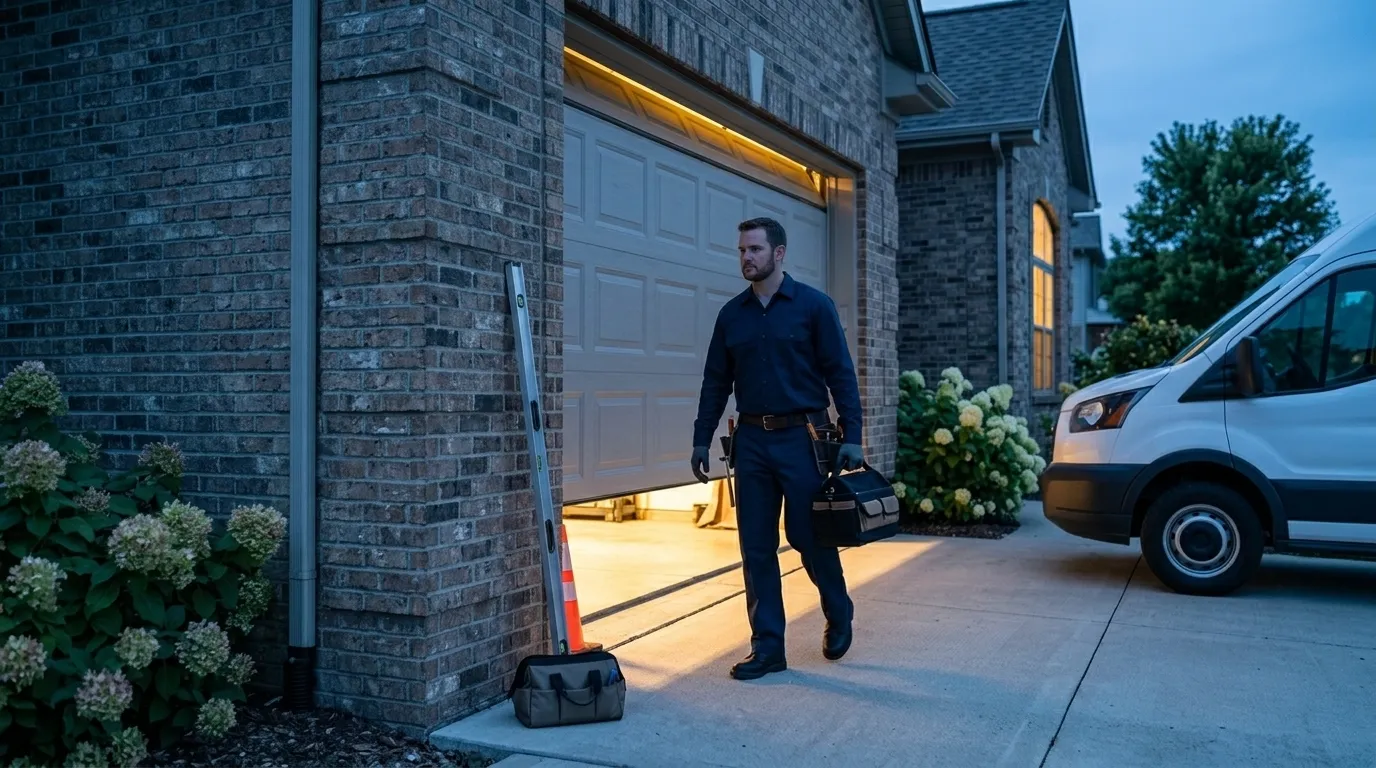
Before you call anyone, find the manual release cord hanging from the trolley on the track - usually a red handle. Pull it straight down and the door should separate from the opener carriage so you can lift it by hand. If it lifts smoothly, your opener lost power, not your springs. Check your breaker panel first; a tripped GFCI or breaker is the most common reason a door goes dead.
If your opener has a battery backup box mounted on the unit, check the little LED on the side. Most units built in the last decade have this feature, but a lot of the openers running in this area were installed to replace units in houses built between 1956 and 1991, and not every owner sprang for the battery add-on when they swapped units out. No battery box, no backup - the door simply won't move on opener power until the power comes back.
Also listen for a chain or belt that sounds looser or slower than usual before the outage even hits. Cold makes older grease and drive components sluggish, and that's often the first sign something was already working harder than it should.
If the manual release cord doesn't let the door lift freely - if it's heavy, catches partway, or drops back down - that's not a power problem. That's a spring problem, and it's not a DIY fix. Torsion springs hold enough tension to cause a serious injury, and that's true whether the power is on or off.
It's also time to call if the opener runs but the door doesn't track straight, if you hear grinding from the motor housing, or if the battery backup light stays red after a few hours of charging. A backup battery that won't hold charge is a part swap, not something to keep testing.
One honest limitation here: we don't stock every battery backup model for every opener brand off the truck. If yours is an older or less common unit, the replacement battery pack sometimes has to be ordered, and that can mean a short wait rather than a same-day fix. We'll tell you that up front rather than promise a fix we can't deliver that day.
An opener without battery backup is just a motor waiting for line power. No power, no lift, no matter how new the door panel is. That's mechanically simple, but the reason it matters more here than it would somewhere with milder winters comes down to climate. This area sits in a cold moderate climate band, and cold snaps are exactly when the grid is under the most strain and outages are most likely - the same stretch of days when you most need the door to open.
Cold also thickens the grease on chain and belt drives, which makes the motor work harder even when the power is on. Combine an aging drive system with a power interruption and you get a door that seems to "die" all at once, when really it's been struggling for weeks and the outage just finished the job.
Houses in this area were mostly built between 1956 and 1991, with the bulk of that stock going up in the 1960s and 70s. Openers from that build era are long gone, replaced one or more times, but the garages themselves and their headroom and track spacing often still reflect that original build.
Across the households we cover - 19,064 total, with 8,134 of them owner-occupied houses - a good number of garages still carry track hardware and door panels from that 1960s-70s build wave, even where the opener itself has been swapped out once or twice. That combination, older hardware plus a newer motor bolted on, is common enough here that it's worth checking both halves separately when something stops working.
Median household income in this area runs $58,834, and at that level, a battery backup unit is often the first upgrade skipped when an opener gets replaced - it adds cost to a repair that already feels urgent. We don't fault anyone for that call, but it does mean a fair share of doors in this area go quiet the moment the power does.
The same pattern holds across the wider service area - out to Wilmore, Versailles, Midway, Winchester, and Paris, roughly thirteen to eighteen miles from the center of things. Same cold winters, same build-era housing stock, same tendency for the battery backup to be the piece that got left off.
Unless your opener has a battery backup unit installed, it runs entirely on line power. When the power cuts, the motor has no way to move the door. This is common in this area because a lot of openers get replaced without adding backup, especially when cost is a factor.
Usually yes, if you use the manual release cord and the door lifts smoothly with normal effort. If it feels heavy or catches, stop - that points to a spring problem, not a power problem, and lifting it by force is how people get hurt.
No. Homes with newer openers that include a battery backup box won't lose function during a power cut. It's the older motor units, common on houses built during the area's main construction era of 1956 to 1991, that are more likely to go dead with the power.
Call now or request a free quote - same-day service on most repairs, upfront written pricing.