Lexington, KY · Garage Door Service
Loading dock, sectional, and rolling steel door repair for shops and warehouses across the Lexington service area, built around the freeze-thaw swings the region actually gets.
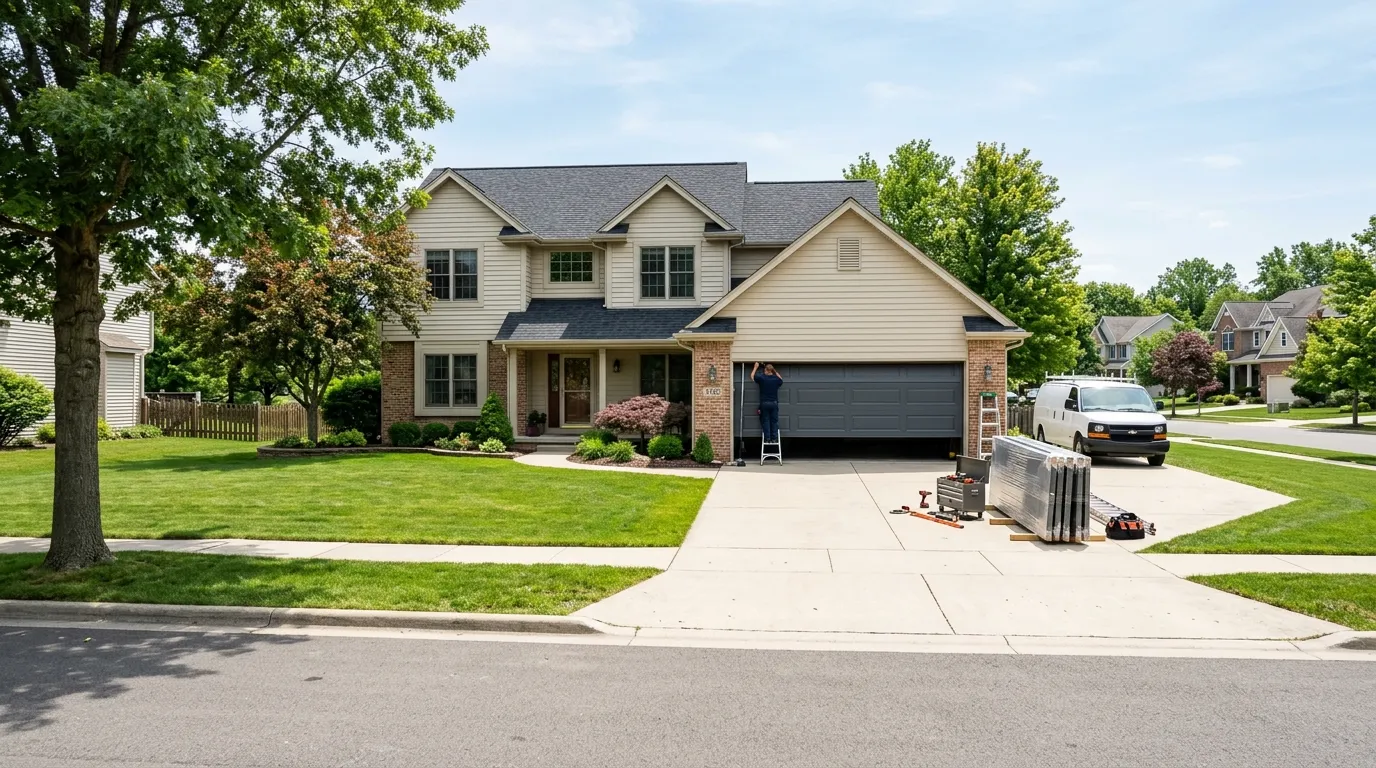
Commercial doors fail differently than the one on a house. A dock door on a chain hoist operator gets opened forty or fifty times a shift, not twice a day, so the first thing we check is cycle wear: rollers, hinges, and the torsion spring doing that extra work. We run the door manually first, before power is even in the picture, to feel where it binds - a door that's hard to lift by hand has a spring or cable problem, not an opener problem, no matter what the motor sounds like.
For rolling steel and high-lift sectional doors we check track alignment with a level, not by eye, because a quarter inch of drift at the header shows up as a stuck door at the floor. If the opener is the fault, we test the logic board and limit switches before swapping anything, since a $30 sensor gets blamed for a lot of $400 board failures.
We run this same process whether the call comes from a shop a few minutes from downtown Lexington or from Wilmore, Versailles, Winchester, Midway, Paris, Salvisa, Burgin, Stamping Ground, Harrodsburg, Frankfort, Lancaster, Cynthiana, or Berea - the whole stretch of ground we cover out of Lexington. One truck, one diagnostic order, wherever the dock is.
The region sits in a COLD-moderate climate band, and that's the detail that drives most of the commercial calls we get. Steel doors left uninsulated - which is most of them, since insulation gets skipped on older warehouse and shop buildings to save on the install - sweat condensation across the inside face every time the outdoor temperature swings back and forth across freezing overnight. That moisture finds its way into torsion spring coils and roller bearings, and over a winter it turns a smooth-running door into one that groans on the way up.
Commercial doors also carry more weight and more daily cycles than a residential door ever sees, so any weakness the climate creates gets found faster. A spring that might last a homeowner another two winters gets stressed hard by forty daily cycles at a loading dock, and it lets go sooner.
Median household income across the service area runs $57,653, and across the 46,262 households here, 17,672 own the house they live in - numbers that tell you the businesses supplying that population are mostly small operations, not chains with a facilities department on call. That's who's dialing us when a dock door won't clear the truck bed on a Tuesday morning.
The call usually starts the same way: the door reverses partway up, or it stops and won't clear far enough for a delivery truck to back in. On a chain hoist operator, that's often a limit switch that's drifted out of adjustment from months of vibration, not a broken part at all - a five-minute fix once we're on site, though it takes a trip to find.
A heavier symptom is a door that's suddenly hard to lift by hand when the power's out, or one where a technician can hear the spring straining before it lets go. That's a torsion spring nearing the end of its cycle count, and on a wide commercial door that spring is under a lot more load than anything on a house - when it breaks, it breaks loud and it breaks the whole door's ability to move until it's replaced.
Rolling steel doors show a different symptom: the curtain binds in the guides, usually a sign the guides have racked slightly out of parallel, which happens over years of a forklift or pallet jack clipping the frame. None of these get better with more force on the pull chain or the wall button. Pushing a stuck door usually turns a service call into a bent-track call, and a bent track costs a lot more than the visit would have.
Some of this is fair to handle yourself. Clearing debris out of the track, checking that the photo-eye sensors are aligned and not caked in dust, and tightening loose bolts on the track brackets are all reasonable weekend jobs, and they solve more nuisance calls than you'd think.
What isn't reasonable is anything involving the torsion spring. Commercial doors run larger springs under more tension than a residential door, and a spring that lets go while someone's winding it can put a bar through a hand or a face. We don't recommend it, and honestly we'd rather lose the small job than have that call go the other way.
One honest limit on our end: some heavy-duty commercial opener parts, especially for older chain hoist units, aren't something we keep on the truck. If your unit needs a part like that, we'll tell you up front that it's a day or two out rather than quote a same-day fix we can't deliver. For a business losing dock access, that delay matters, and we'd rather you know it going in than find out when the truck's already loaded and waiting.
That depends on where you're at and what's already on the schedule that day - we don't have a blanket response time to promise. Call and we'll tell you honestly where you fall in the queue rather than give you a number we can't back up.
Yes. Chain hoist units are common on older dock doors in this area and they fail differently than a residential-style opener - usually at the limit switches or the chain itself rather than the motor. We check both before assuming a board or motor is the problem.
The region sits in a COLD-moderate climate band, and an uninsulated steel door sweats condensation whenever the temperature swings across freezing. That moisture works into spring coils and bearings over a season, which is why a door that ran fine in fall starts groaning by January.
Depends on how far out of parallel the guides are and what else has taken damage from the same impact. A single bent section is usually a repair. A track that's racked at multiple points, or a curtain that's been forced through it, is often cheaper to replace outright - we'll tell you which one you're looking at before we quote anything.
By Neighborhood
We also handle commercial garage door in these Lexington-area suburbs.
Call now or request a free quote - same-day service on most repairs, upfront written pricing.