Lexington, KY · Garage Door Service
Frankfort has roughly 12,763 households, a fraction of the wider Lexington service area. We travel 26 miles out for commercial door calls here - here's what that means for scheduling and cost.
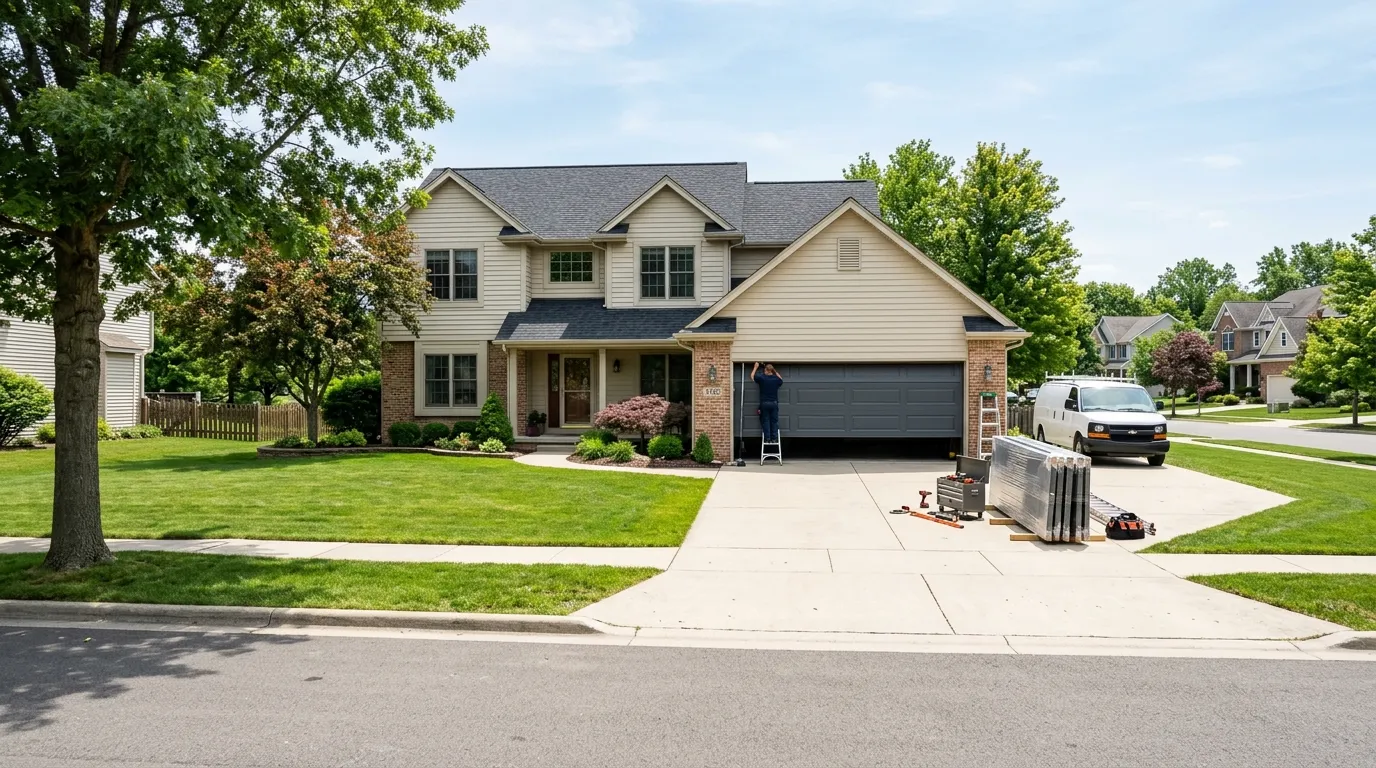
A commercial roll-up or sectional steel door isn't the same animal as a residential one, and Frankfort's building stock leans older than a lot of what we see closer to Lexington - most housing here dates to 1971, right in the middle of the wider service area's 1956-1991 range. Commercial buildings from that same stretch often carry doors and openers matched to it: heavier gauge panels, older jackshaft or chain hoist setups, torsion springs sized for wider openings than a house door. You can grease a track and tighten a loose bracket yourself. What you shouldn't touch is a broken torsion spring under load, a misaligned photo-eye on a high-cycle commercial opener, or cable that's frayed on a door that weighs several hundred pounds. That's not a DIY savings - it's a trip to the ER savings you're skipping. If the door is a small walk-in service door on an outbuilding, sure, handle the easy stuff. Anything with a motor rated for repeated daily cycles, call it in.
One honest limit: we don't stock every commercial opener board or gate operator part on the truck. Some commercial hardware, especially anything discontinued or proprietary to a builder from that 1960s-70s wave, means a return trip once the part's in hand.
We don't have a flat number to hand you here, and we're not going to invent one. Commercial door cost swings hard depending on door width, spring count, whether the opener is a residential-grade unit somebody installed on a commercial door years back (common in smaller Frankfort operations and warehouses), or a proper commercial-cycle motor. Frankfort's median household income sits at $54,438, lower than the $57,653 median across the wider area we cover - that doesn't set your repair price, but it does tell you this isn't a market where every shop or small business is running a top-shelf commercial door setup. A lot of what we find here is older hardware kept running past its expected life because replacing it wasn't in the budget. That changes the job: sometimes it's cheaper to fix, sometimes the door's parts are so old that patching it costs more over two visits than replacing the section outright. We'll tell you which one you're looking at before we start charging for either.
We run out of Lexington, and Frankfort sits about 26 miles out - that's baked into how we schedule the day, not something we pretend isn't there. We don't have a branch or drop point in Frankfort itself, so a commercial call here gets bundled with other stops in that direction where we can, which keeps the trip efficient without inventing a same-day promise we can't back. Tell us upfront if the door is fully down and blocking access - a stuck commercial door on a loading bay or shop front is a different priority than a noisy track on a door that still opens. The more you can tell us about the opener brand, door width, and whether it's one door or a bank of several, the better we can load the truck before we leave Lexington instead of guessing and coming back.
The trouble spot in Frankfort is almost always hardware age matching building age. A door installed when the building went up in the early 1970s, on original torsion or extension springs, on a track nobody's re-shimmed since - that setup can look fine and still be one cycle from a cable snapping. We also see it where a business swapped the opener at some point but kept the original door and track, so the new motor is fighting old rollers and a slightly bowed track it was never sized for. That mismatch burns out openers early and it's an easy thing to miss until the motor's already dead.
Winter is the other place this goes wrong. The service area sits in a cold, moderate climate band, and steel commercial doors from that older stock don't always have the weatherstripping or insulation a newer door would, so cold snaps make brittle seals crack and expose the header to wind load the door wasn't built to handle in a tight bay. None of that is unique to any one building - it's a function of the door's age lining up with the season.
The call we get most from this direction is a commercial door that's slow to close, or closes partway and reverses - usually a photo-eye or limit switch issue on an opener that's been asked to run more cycles a day than a residential unit ever would. On the older 1970s-era stock, we also hear about doors that groan or bind partway up, which is often track misalignment that's been building for years, not a sudden failure. Cold-weather calls tend to be different: a door that worked fine in October and won't seat flush against the header once temperatures drop, because the seal has hardened and the door is fighting a gap it didn't have in summer. None of these are dramatic on their own, but on a commercial door that a business relies on to open every morning, a slow symptom becomes a locked-out loading bay fast.
Figure the drive first - 26 miles each way from Lexington adds real time to a Frankfort commercial call before a wrench even comes out, and we plan the visit around that rather than pretending it's a five-minute hop. Once we're on site, a straightforward opener or spring swap on a standard commercial door usually runs shorter than a job involving a bank of multiple doors sharing one drive shaft, which is common enough on older buildings in this stretch. If the hardware turns out to be discontinued or nonstandard - more likely the older the building - the actual repair might wait on a part, even if the diagnosis happens the same day. We'd rather tell you that upfront than promise a same-visit fix we can't guarantee from 26 miles out.
No. We run this job out of Lexington, about 26 miles away, and travel out for commercial calls. There's no local depot here, so we bundle trips where we can, but we won't promise a response time we can't back from that distance.
The service area sits in a cold, moderate climate band, and older commercial doors - common in Frankfort given the building stock's age - often have weatherstripping that's hardened over the years. That gap lets cold air and wind load hit the header in ways a newer, better-sealed door wouldn't.
Depends on what's failed and how old the hardware is. If the track and drum are original to a building from the 1960s-70s wave, parts can be hard to source, and repair sometimes costs more over two visits than replacing the section. We'll tell you which side of that line your door falls on before we start work.
Call now or request a free quote - same-day service on most repairs, upfront written pricing.