Lexington, KY · Garage Door Service
Opener repair for Harrodsburg homes built mostly in the early 1970s, where original chain-drive units and worn gears are the common call. Traveled from Lexington, 25 miles out.
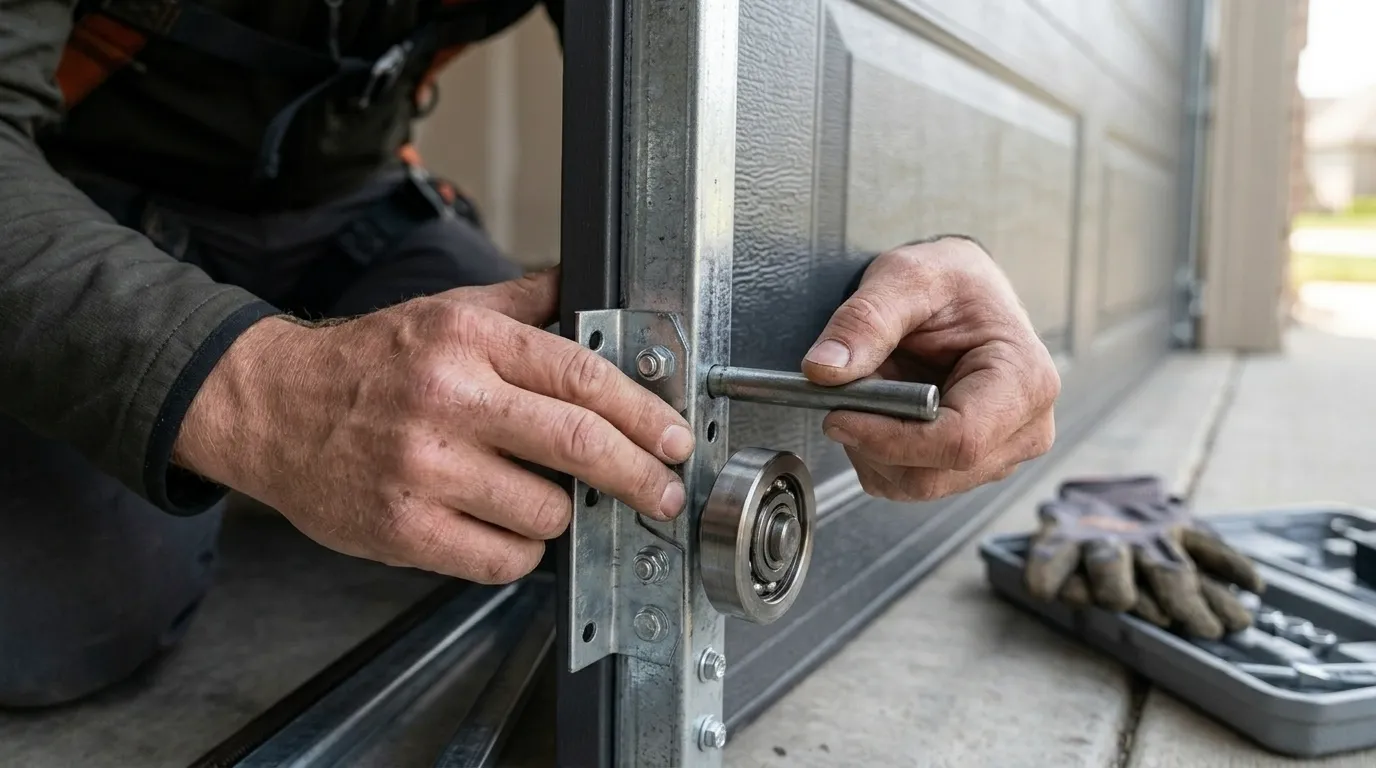
The call we get most from Harrodsburg is an opener that hums, clicks, or runs the motor but the door doesn't move. That's usually a stripped drive gear or a worn sprocket on the chain, not the motor itself - and it's a part swap, not a full unit replacement, if you catch it early. A homeowner with the right socket set and a free afternoon can sometimes get the housing open and confirm which part failed.
What you're working with in Harrodsburg makes the DIY math different than it is on a newer street. The median home here was built around 1971, which puts a lot of these garages on original or first-generation replacement openers - chain-drive units with logic boards that don't talk to a phone app and don't have the safety-sensor wiring modern code expects. If you're not sure your opener has working photo-eye sensors, that's not a part to guess on. A misaligned or missing sensor is a door that can come down on something, and that's where we'd tell you to stop and call rather than push through it yourself.
We're honest that we can't get to every call same-day out of Lexington - we travel to Harrodsburg, we don't have a truck sitting there - so if your opener has failed and the door is stuck open, a temporary manual release and a padlock on the track is the safe stopgap until we arrive.
Harrodsburg's housing stock centers on 1971, right in the middle of the wider 1956-1991 build era that covers most of this service area. Openers installed in the 1970s and 80s, and the first-generation replacements that went in on those same houses in the 90s, are now old enough that their capacitors and drive gears are simply worn out from cumulative cycles - not from any one dramatic failure.
Cold, moderate winters play into it too. A garage in this climate band swings from a warm afternoon to a hard overnight freeze, and that temperature swing stiffens old grease on the rail and inside the gear housing. A motor that has to work harder to push a stiff door strains the gear first - that's the mechanical link between the climate and the specific part that breaks.
We also see logic boards that have taken a lightning surge or a bad splice from a DIY rewire over the decades a house has stood. None of this is unique to any one street in town - it's what you'd expect from a housing stock that's now solidly 50 years old carrying openers that are, in a lot of cases, their second or third install.
Harrodsburg sits about 25 miles from our shop in Lexington, so a visit here gets scheduled as a routed trip rather than a walk-up call. That doesn't mean it's a low priority - it means we ask a few more questions up front (what the opener does when you push the button, whether the light blinks, whether the door moves at all) so the tech who comes out has the right gear part or board on the truck instead of making a second trip.
If you're comparing openers across our service area, Harrodsburg's household income runs lower than some of the towns we cover - median here is around $46,821, against a service-area median near $57,653 - which is part of why we'd rather diagnose a repairable gear or capacitor issue than default to selling a new unit when the old one still has life in it.
Most opener calls in Harrodsburg break down into one of three repairs: a drive gear or sprocket replacement on the chain unit, a logic board swap when the motor runs but nothing communicates to the sensors or remote, or a full capacitor and motor check when the unit won't start at all. We test the travel limits and force settings after any of those repairs - an opener that's been fighting a stiff spring or a bent track for years often has its force set too high, which is its own hazard once the new part goes in.
We also check the photo-eye safety sensors on every opener job, not just the ones where that's the complaint. On a unit installed before current code, we'll tell you plainly if the sensor wiring isn't there to add, and what that costs versus what a straight gear swap costs - that's a call we let the homeowner make, not one we make for them.
One limitation worth saying outright: if the opener is a chain-drive unit old enough that the manufacturer no longer makes the circuit board, we won't pretend we can source a discontinued part overnight. That's a replacement conversation, not a repair one.
The specific complaint we hear from Harrodsburg is almost always one of these: the opener runs but the door doesn't lift (gear or sprocket), the door reverses partway up or down for no reason (force setting or a sensor problem), or nothing happens at all when the button's pressed (board or capacitor). Grinding or clicking from the housing while the door sits still is the stripped-gear sound specifically - the motor is spinning but not catching the chain.
A door that opens fine on the wall button but not on the remote is a different fault line entirely - usually the remote's battery or the receiver antenna, not the drive train - and it's worth mentioning because it's the one opener problem in Harrodsburg that has nothing to do with the age of the house at all.
Depends what's broken. A stripped gear or worn sprocket is a cheap, quick fix on almost any chain-drive unit, original-era units included. If the logic board is dead and the manufacturer no longer makes it, or the motor itself has burned out, replacement usually costs about the same as chasing discontinued parts - we'll tell you which situation you're in before we start.
Cold stiffens the grease on the rail and inside the gear housing, so the motor works harder to move the door. On an opener that's already got a worn gear or a weak capacitor, that extra strain in cold weather is often what finally makes the failure show up, even though the part had been wearing down for months before that.
We travel from Lexington, about 25 miles out, so a Harrodsburg call gets scheduled as a routed visit rather than a walk-up. We ask a few diagnostic questions when you call so the tech arrives with the right gear or board already on the truck.
Not all of them. A lot of Harrodsburg homes date to the early 1970s, and openers installed on those houses over the decades sometimes predate current photo-eye sensor requirements. We check for this on every opener call and tell you plainly if it's missing rather than assuming it's there.
Call now or request a free quote - same-day service on most repairs, upfront written pricing.