Lexington, KY · Garage Door Service
Frankfort homes built around 1971 still run original steel rollers on steel stems. We drive out from Lexington to swap them for sealed nylon before the track wears through.
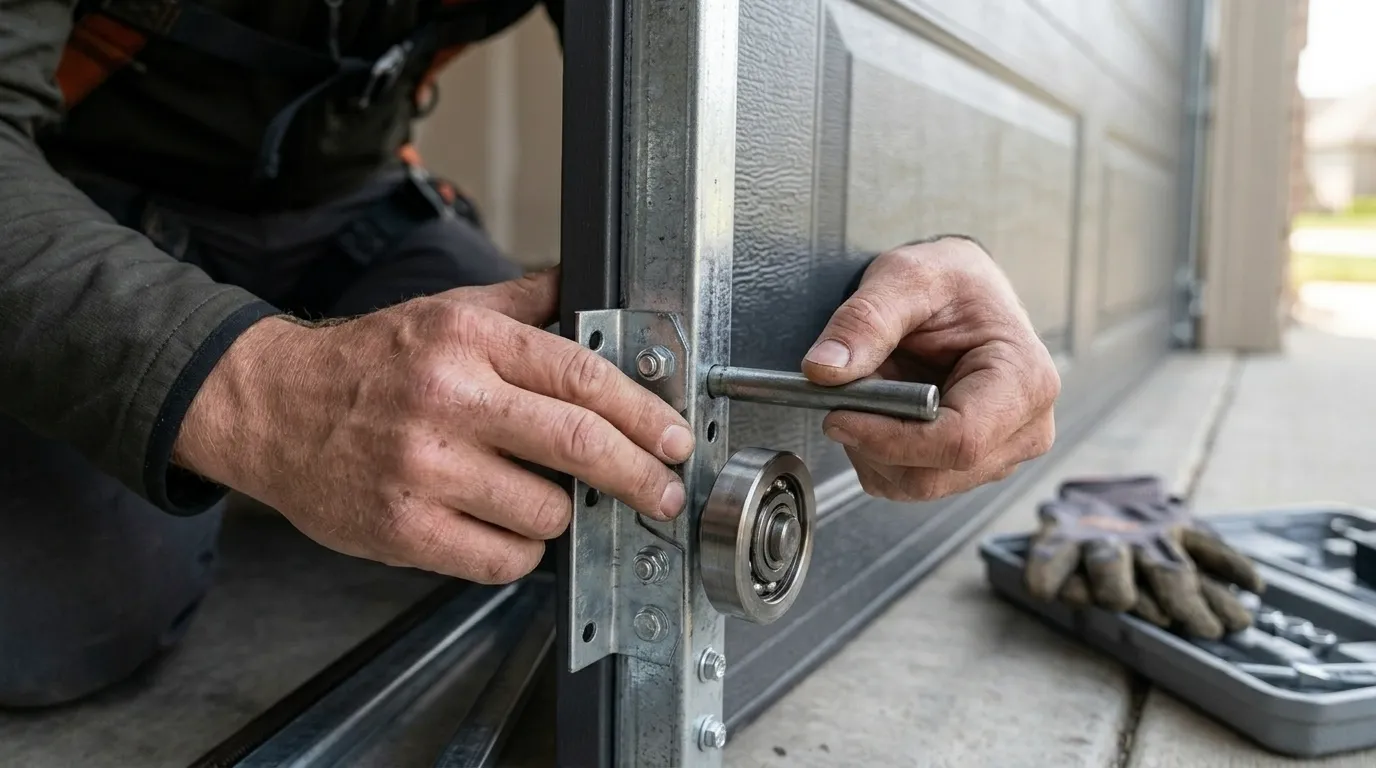
If your house in Frankfort went up anywhere near 1971 - and a lot of them did - there's a decent chance the rollers on that door have never been touched. Steel rollers on steel stems were standard hardware in that era, and nobody replaces a roller until it starts screaming or falls out of the track. So the question isn't really "can I do this myself," it's "what else on that door is original 1971 hardware that a roller job is going to expose."
Swapping rollers yourself is possible if the door is off its opener and you know how to release spring tension safely - that's the part that puts people in the ER, not the rollers. If you've got a torsion spring you've never touched and don't know its wind, that's not a DIY afternoon.
We'll be straight with you: a basic roller swap on a door in decent shape is not a hard job for someone mechanically comfortable. What we watch for on Frankfort calls specifically is track that's worn to match those old steel rollers - swap to nylon on a track that's been grooved by 50 years of steel and the new roller rides rough until the track gets addressed too.
We don't post a flat number here because roller jobs split into two very different scopes: a straight roller swap, and a roller swap that turns into a track or hardware job once we're looking at what's actually on the door. Frankfort's housing stock, built mostly in that 1956-1991 window with a median around 1971, means we go into most of these calls expecting original steel rollers and often original track brackets too.
Median household income in this part of the service area runs $54,438, and we price roller work the same way we would anywhere else we drive to - by what the door needs, not by zip code. What changes the number is whether we're replacing 10 rollers on one side or the full set, whether the track needs straightening or swapping, and whether the bearings at the bottom brackets are shot along with the rollers.
We'll give you the number after we look at the door, not before. Call and describe what you're hearing and we can usually tell you which end of that range you're in.
We're based in Lexington and drive out to Frankfort for this work - it's about 26 miles, so we schedule roller calls out here alongside other jobs on that side of the county rather than as one-off trips. That means we're not a same-hour dispatch for a roller squeak, but we do get out regularly.
When you call, tell us the door's rough age if you know it - if the house was built anywhere near 1971, say so, because it changes what we bring on the truck. Steel rollers, original track brackets, and bottom brackets that have never been swapped all point to a job that's more than just popping in new rollers.
We'll ask a few questions about the noise - grinding, popping, or a door that jumps in the track - because that tells us whether we're looking at rollers alone or rollers plus something the rollers were compensating for.
The failure mode we see on original-era doors in Frankfort isn't the roller itself - it's what the roller has been hiding. A steel roller riding in a steel track for decades wears both parts unevenly, and by the time the roller is loud enough to notice, the track it rides in has often worn a matching groove. Put a new roller, even a good sealed nylon one, into a grooved track and it still won't ride smooth.
The other thing that catches people: bottom bracket bolts on doors this old are frequently rusted or stripped from cycles of heat and cold - this area sits in a cold-moderate climate band, and that swing matters more to old steel hardware than people expect. We've had jobs where the roller swap was the easy 20 minutes and the stripped bracket bolt took longer to sort out.
Honest limitation: if the track is warped or the bracket is cracked, we're not going to just cram new rollers in and call it done. That's a track or bracket job, and telling you it's "just rollers" when it isn't just wastes your money in six months.
Grinding or grating when the door moves, especially near the top or bottom of the track, is the classic sign a steel roller is worn past its bearing surface. A rhythmic thump as the door travels usually means one roller has flattened on one side and is bouncing in the track every rotation. Popping sounds, particularly at the curved section of track, point to a roller that's binding rather than rolling.
On 1970s-era doors across Frankfort, we also see rollers that have simply seized on the stem - the roller doesn't spin at all, it just drags, which wears a flat spot and eventually chews into the track itself. That's usually the loudest and worst-looking wear pattern because the door's had to fight the track on every cycle.
If the noise has been building slowly over months, it's wear. If it started suddenly and the door won't move at all, that's a different call - possibly a spring or cable, not a roller, and worth mentioning when you phone us so we bring the right parts.
A straight roller swap - all rollers, no track or bracket work - usually runs under an hour once we're on site. Add track straightening or a bracket swap because of wear from decades of original steel-on-steel contact, and the visit runs longer, since that's a different repair riding along with the roller job.
We don't stock every bracket variant that shipped on doors from the early 1970s, so if your door needs a less common part, that can mean a short wait rather than a same-visit fix. It doesn't happen on every call, but on original hardware from that era, it's common enough that we mention it upfront rather than surprise you at the door.
If the house was built around 1971 - typical for a lot of Frankfort - and the door has never been serviced, the rollers are very likely original steel-on-steel hardware. Signs include a dull metallic roll sound rather than a smooth quiet one, and rollers that look plain steel rather than the white or gray nylon common on newer replacements.
We stock common roller sizes for the swap itself, but original bracket or track hardware from the early 1970s isn't always something we carry for every variant. If your door needs a less common bracket, that can mean a short wait rather than a same-visit fix.
Usually yes, if the track and brackets are still sound - rollers are a cheap fix compared to the door misbehaving on worn steel. But if the track is warped or the brackets are cracked from age, roller replacement alone won't solve it, and we'll tell you that rather than sell you a partial fix.
No, we run out of Lexington and drive to Frankfort for jobs - it's about 26 miles, so we schedule roller calls here alongside other work on that side of the county rather than as a same-hour dispatch.
Call now or request a free quote - same-day service on most repairs, upfront written pricing.