Lexington, KY · Garage Door Service
Berea's housing mostly went up in the 1970s-80s, later than most of the service area. That means different springs, different openers, different failure points. We drive out from Lexington.
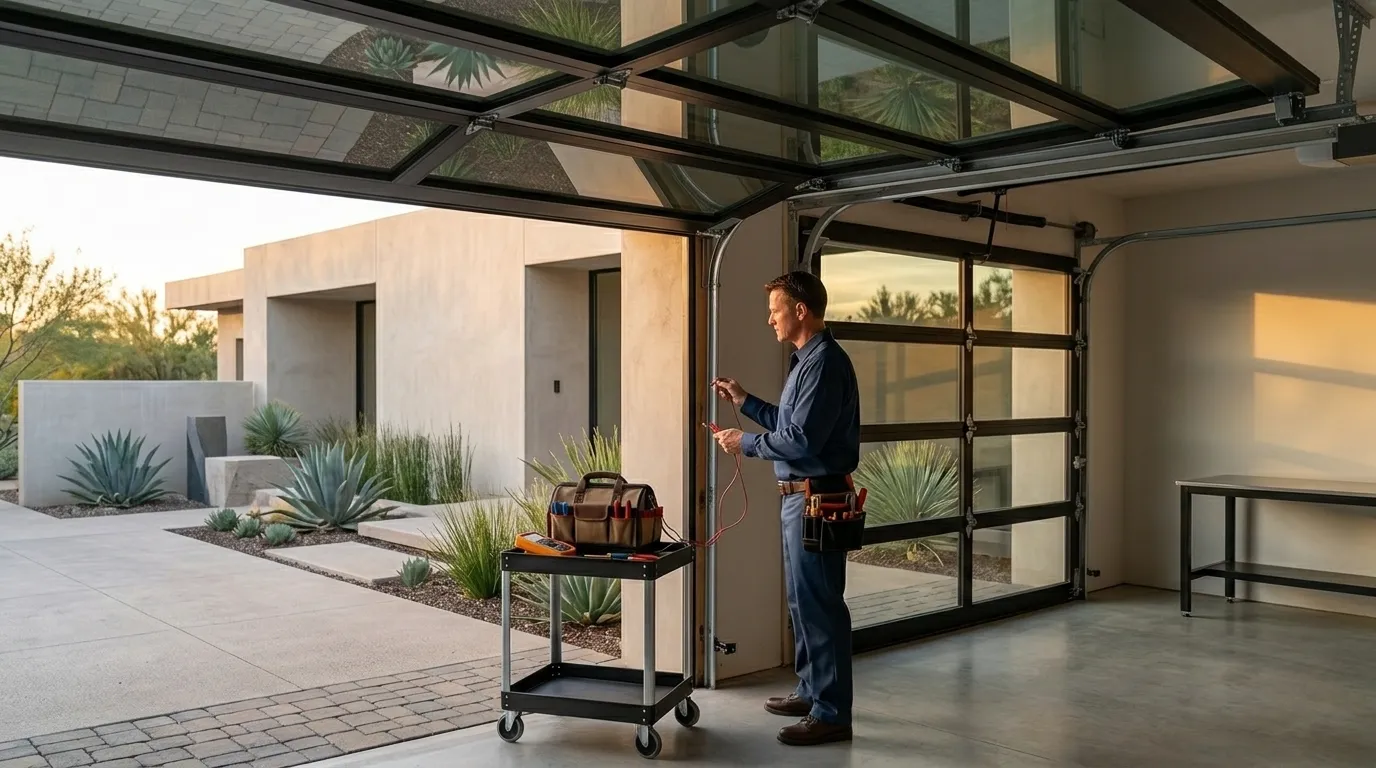
Berea sits at the newer edge of the housing stock we work on. Most of the service area's houses date to the 1960s and 70s, but Berea's median build year lands around 1988 - late enough that a lot of original doors are steel sectional units on torsion springs rather than the older extension-spring setups you still find in the earlier-built parts of the territory. That matters for pricing. A torsion spring swap on a standard double door runs different money than an extension-spring job, and the openers from that era are more often chain-drive units bolted to hardware that's aged out of easy adjustment. We quote by what's on the door, not by zip code, but knowing the likely hardware before the truck rolls out from Lexington means fewer surprises once we're standing in the driveway. Berea's median household income runs close to $56,500, and we've found that tracks with owners who want a straight repair estimate before anything gets touched, not an upsell. We don't have a published flat-rate sheet to hand you here - every door has its own spring count, track condition, and opener age - but we'll tell you the number before we start, not after.
We run out of Lexington, and Berea is about 29 miles out - the far edge of our regular coverage, alongside places like Cynthiana and Lancaster. That distance is worth saying plainly: we don't keep a crew or a stocked van sitting in Berea, so a same-hour walk-up isn't something we can promise the way a shop based in town could. What we can do is schedule the visit with enough lead time to bring the right spring size and the right opener parts for a house built in the late 80s rather than guessing off a 1960s hardware list. If you're calling about a dead opener or a spring that let go overnight, tell us the door's approximate age and whether it's steel or wood-faced - that alone narrows down half of what we'd otherwise ask on-site. Berea has around 5,694 households, which isn't a large enough base for us to justify a permanent depot, so every visit is planned around the drive from Lexington. That's the honest limitation: we're good at this door, but we're not local in the sense of being five minutes away.
A door built when Berea's houses went up - late 1970s through the late 80s - usually has a torsion spring mounted on a steel shaft above the opening, not the side-mounted extension springs you'll see on older stock elsewhere in the service area. Torsion springs store a dangerous amount of tension and they don't forgive a wrong wrench or a missing winding bar. That's not a scare tactic, it's just the mechanics of the part. Where DIY makes sense: tightening loose hinge bolts, lubricating rollers and hinges, clearing debris off the track, replacing a dead remote battery, or squaring up a bent bottom bracket that isn't under load. Where it doesn't: touching the spring itself, adjusting the torsion bar, or working on the cable drums. If your opener from that build era is a chain-drive unit and it's grinding or slipping, that's often a gear or sprocket issue inside the housing - doable for someone comfortable with a screwdriver and a manual, but the part itself can be hard to source for an opener that old. That's a real limitation on our end too: some 1980s-era opener parts are simply discontinued, and replacement is the honest answer, not repair.
The most common mistake we see on doors from Berea's era is someone replacing a broken spring with whatever size a hardware store had on the shelf, instead of matching the wire gauge and wind to the door's actual weight. A mismatched spring either won't lift the door all the way or will slam it down uncontrolled - both are dangerous and both mean paying for the job twice. The second failure point is the opener's safety reversal - on a door this age, if the opener was ever swapped out without resetting travel limits and force settings correctly, the door can seem fine for months and then close on something it shouldn't. We check that on every service call, whether or not it's why you called. Third: cold-weather stiffening. This part of Kentucky sits in a moderate cold climate band, and older lubricant on 30-plus-year-old rollers and hinges gets noticeably stiffer once temperatures drop, which shows up as a door that struggles on the first cold morning of the season and seems fine by afternoon. Owners often assume that's the opener failing when it's really just old grease. None of these are exotic problems - they're just specific to a door of this age, which is why matching the fix to the actual hardware matters more than a generic tune-up.
No. We work out of Lexington and Berea is about 29 miles out, near the far edge of our regular coverage. We schedule visits rather than offering same-hour walk-ups, and we bring parts sized for the hardware typical of Berea's housing stock rather than guessing on-site.
Berea's houses mostly went up between the late 1970s and late 1980s, later than much of the service area. That era is dominated by torsion-spring doors and chain-drive openers, which need different parts and adjustments than the extension-spring setups common on older houses nearby.
We don't recommend it. A torsion spring, which is what most Berea-era doors use, holds enough tension to cause serious injury if the winding bars slip. Simpler jobs like lubricating rollers, tightening hinges, or clearing the track are reasonable to handle yourself.
We check the safety reversal and force settings on every visit, regardless of why you called. On doors this age, especially if the opener was swapped at some point without a full reset, the reversal can drift out of adjustment without any obvious symptom until it fails to stop on something.
Call now or request a free quote - same-day service on most repairs, upfront written pricing.